
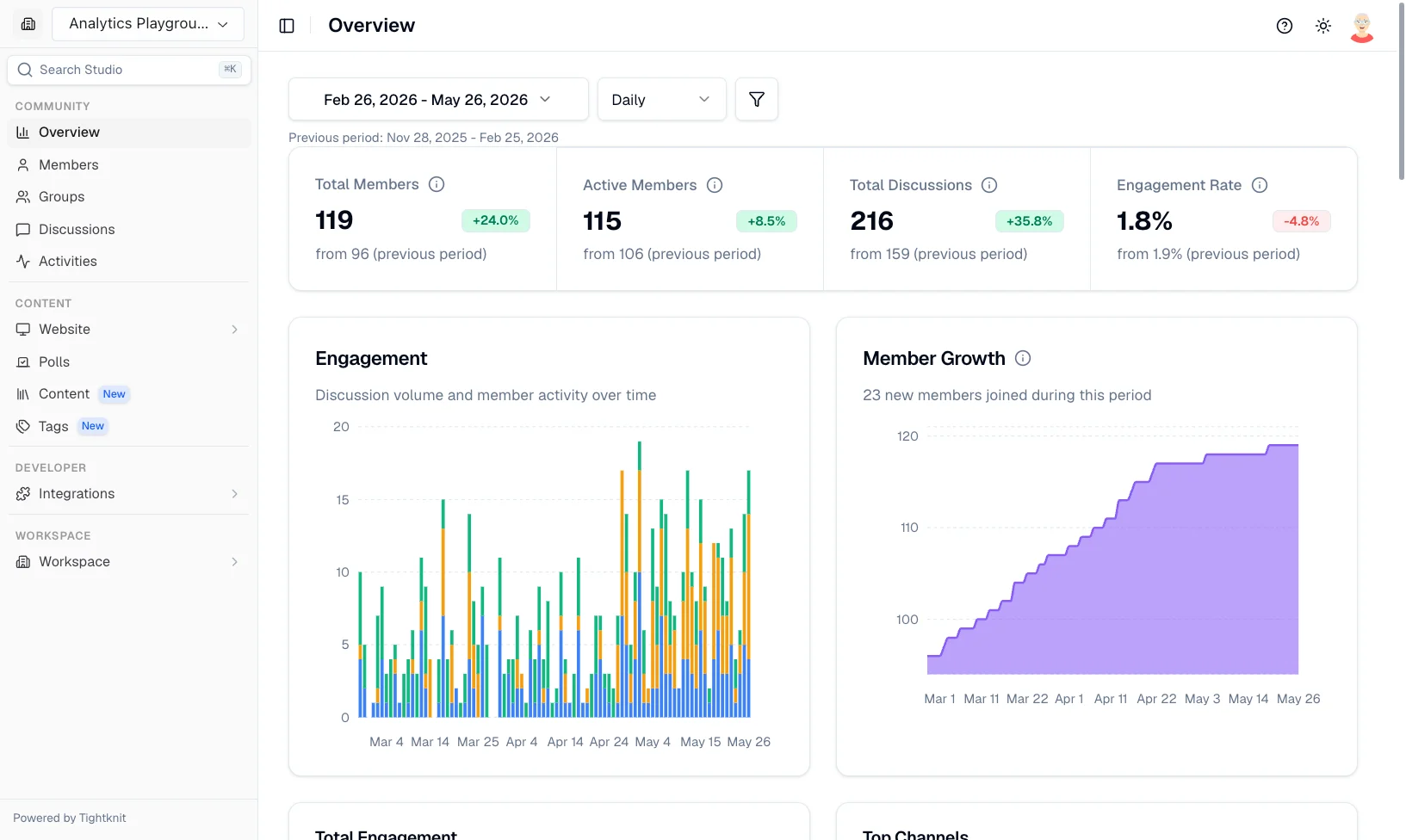
Studio dashboard overview
Studio sections
The sidebar groups pages into Community, Engagement, Content & Site, and Integrations, with Settings pinned at the bottom. You only see the pages your role grants, so your sidebar may be shorter than what follows. See Access and roles.Community
Who your members are and how the community is doing overall.- Overview - the analytics dashboard: member growth, engagement rate, response times, and the members whose activity is rising or falling.
- Members - search, filter, create, and manage member profiles.
- Groups - collections of members used for permissions, assignments, and targeting.
- Onboarding - the automatic welcome message new members receive.
- Calendar - events, journeys, and scheduled polls on one calendar, where you can reschedule them by dragging.
- Activity - the chronological record of every community interaction. Not in the sidebar; reach it with Cmd+K.
Engagement
The programming you run for your community.- Discussions - every synced message, with full threads, and publish controls for your community site.
- Feeds - the connections between Slack channels and pages on your site.
- Events - create, publish, and manage events and registrations.
- Polls - create polls and read per-option results and voter breakdowns.
- Awards - badges, credentials, and profile frames you give to members.
- Journeys - multi-milestone paths that guide members from joining to contributing.
- Slack channels - the full channel directory and each channel’s Tightknit state. Not in the sidebar; reach it with Cmd+K.
Content & Site
Everything that configures or measures your public community site, plus your content library. Site expands into its own set of pages:
Alongside Site:
- Content Library - curated collections of links and recordings.
- Tags - tag groups and tags for organizing content.
Integrations
- Slack - connection status, bot profiles, Slack Connect, team notifications, and sync history.
- Salesforce - sync community data to your CRM.
- API Keys - keys for the Tightknit API.
- Webhooks - endpoints for event notifications.
- MCP - connect AI agents such as Claude, ChatGPT, and Cursor to your community.
Settings
Pinned to the bottom of the sidebar.- Workspace - workspace configuration and Studio user access.
- Billing - subscription, payment method, and invoices.
- Team filter - identify teammates so you can exclude them from analytics.
- Audit - member imports, sync jobs, and community-wide authentication events.
Studio, Slack, and your AI agent
Most community management tasks can be done in three places, and they stay in sync:- Studio is the full surface. Everything is available here, and data pages such as Discussions, Members, and Analytics only exist here.
- The Slack app home offers the most common settings and actions without leaving Slack, organized into modules. See the Slack app guide.
- An AI agent connected through the Tightknit MCP server can read your community and make changes on your behalf, from Claude, ChatGPT, or Cursor.
Finding things fast
Press Cmd+K (Ctrl+K on Windows) to open the command menu from anywhere in Studio. Use the sidebar search box to search your community’s posts, comments, and resources. See Search in Studio.Limitations
- The Member Since date of members who joined the community before Tightknit was installed may not be accurate. In these cases it may show the date Tightknit was installed.
- Analytics and Discussions only cover activated channels.