

The Slack channels list in Studio
Studio’s Slack channels page is the full directory of channels in your connected Slack workspace, with each channel’s Tightknit state alongside it. It answers “is this channel activated?” and “where does its content end up?” at a glance. It is not in the Studio sidebar. Reach it with Cmd+K and typechannels, or go straight to Slack channels.
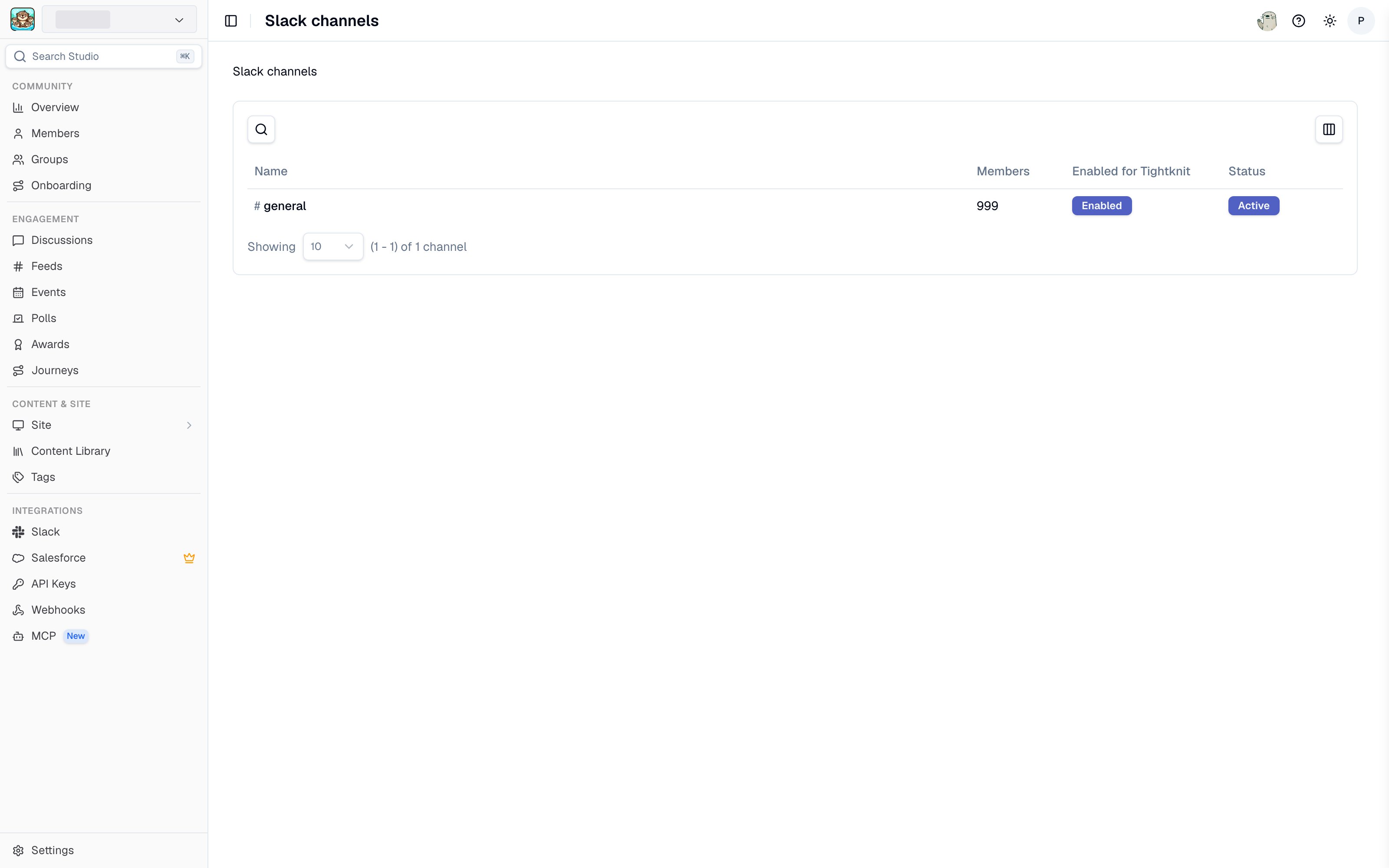
The Slack channels page in Studio
Use the View dropdown to show or hide columns, and click a channel to open its detail page with its synced messages and Tightknit configuration.
The Enabled for Tightknit and Feed columns together tell you which of the three channel states a channel is in.
Viewing Slack channels requires community data access. See Access and roles.
Understanding Channel States
Slack channels in your workspace can exist in three different states with Tightknit:1. Non-Activated Channel (Default State)
When the Tightknit app is added to your Slack workspace, all channels start in this state:- Tightknit is not aware of the channel
- No data ingestion or message tracking occurs
- Slack-related features (polls, anonymous posting, etc.) are not available
- The channel does not appear in the Tightknit dashboard
2. Activated Channel (No Feed)
When you activate a channel for Tightknit (as described below):- Tightknit begins ingesting data from the channel, including messages and replies
- Channel activity appears in the Analytics Studio for insights and reporting
- Slack-related features become available (polls, anonymous posting, thread engagement reminders, etc.)
- The channel appears in your Tightknit dashboard under Channels & Feeds
- Messages are not synced to the community site unless a Feed is connected
- A disclosure message is posted in the Slack channel informing members that messages are synced to Tightknit (see Sync disclosure below)
3. Activated Channel with Feed
When you create a Feed for an activated channel:- Everything from the activated state (above) remains active
- Messages are synced to the community site according to the Feed’s sync settings
- Posts become publicly accessible on your community site (subject to Feed visibility settings)
- When the Feed is set to Public visibility and the community site is active, a second disclosure message is posted in the channel letting members know their messages can appear publicly on the community site
When a channel is deleted in Slack
When a public or private channel is deleted in Slack:- A Feed connected to the channel is preserved along with its posts and comments on the community site. Tightknit posts a notice in your Tightknit Hub channel, and you can archive the Feed if you no longer want it shown.
Activate a Channel in Slack
To activate one of your Slack channels to work with Tightknit, click theActivate Channel button within the Channels & Feeds settings section.

Activate Channel button
The Tightknit app must be within the Slack channel to sync posts to the Feed.
You must add the app to private channels. You can do this either by tagging it
in a message with an @mention, or through channel settings:
1. Open the Slack channel
2. Click on the channel name at the top of the page to open the channel details
3. Click on the
4. In the Apps section, click
5. Add the Tightknit app
1. Open the Slack channel
2. Click on the channel name at the top of the page to open the channel details
3. Click on the
Integrations tab
4. In the Apps section, click
Add apps 5. Add the Tightknit app
Channels & Feeds section. At the end of the row will be an overflow menu button ••• with three dots, used to access the channel and Feed settings:

Channel row with overflow menu
Deactivate Tightknit within Channel
To deactivate the Tightknit app within one of your activated Slack channels, select theDeactivate Channel option within the ••• dropdown menu for the channel. The app will no longer be integrated in this channel, and Tightknit features will not be available. Deactivation is solely related to Tightknit and has no other effect on the functioning of the Slack channel itself.
To re-activate a channel, simply repeat the steps above to activate the channel for Tightknit.
Sync Disclosure
Tightknit automatically posts disclosure messages in the Slack channel so members know their messages are being synced. The activation and public-visibility disclosures are posted as the Tightknit bot and appear as regular channel messages visible to all members. The member-join disclosure is ephemeral, visible only to the joining member.Each disclosure is posted once per transition. Deactivating a channel and re-activating it posts the activation disclosure again, because the channel transitions back to the enabled state. A Feed that is already public does not re-announce when its settings are saved without a visibility change.