Create a Feed in Tightknit Studio or Slack to monitor a Slack channel and control when and how its messages are posted to your community site.
The Tightknit community site is required to create Feeds.
Feeds are the backbone of all posts in your community site.
Each Feed is configured to monitor your Slack channel and control when and how messages are posted to the site. Feeds can be managed from the app settings under the Channels & Feeds section.When you activate a Slack channel, Tightknit automatically creates a Feed for it. By default this Feed is disabled and is not exposed to your community site. In most cases you don’t create a Feed from scratch. Instead, you configure an existing Feed’s settings to control how (and whether) its messages sync to your community site.
Did you know you can create one with our MCP server too? Try asking your agent: “Create a standalone Announcements feed on our site.” or “Create a new #product-updates Slack channel and connect a feed to it.”
Go to Feeds under Engagement and click Create feed. Choose a kind:
Existing Slack channel - Connected to a channel you already have, so messages sync into it. Creating the feed activates the channel for Tightknit. Private channels appear only once @Tightknit has been invited to them.
New Slack channel - Creates the channel in Slack first, then connects the feed to it. Adds both your user and the Tightknit bot as members of the channel.
The connected channel cannot be changed after a feed is created. Private channels are greyed out unless your plan allows connecting them.
Then set:
Name - What members see.
Slug - Used in URLs. Lowercase letters, numbers, - and _ only.
Message sync strategy - Manual, where admins sync individual messages with the Slack shortcut or from Studio, or Automatic, where every new message in the channel syncs. Switching applies to new messages only.
Community site access - Who can see the feed on your site. A feed on a private Slack channel cannot be exposed publicly.
List display - How items look in the feed: Card, Snippet, Compact, or Changelog.
Post display - How each post’s page looks: Discussion or Blog.
Navigation sidebar emoji - Shown at the top of the feed on your site.
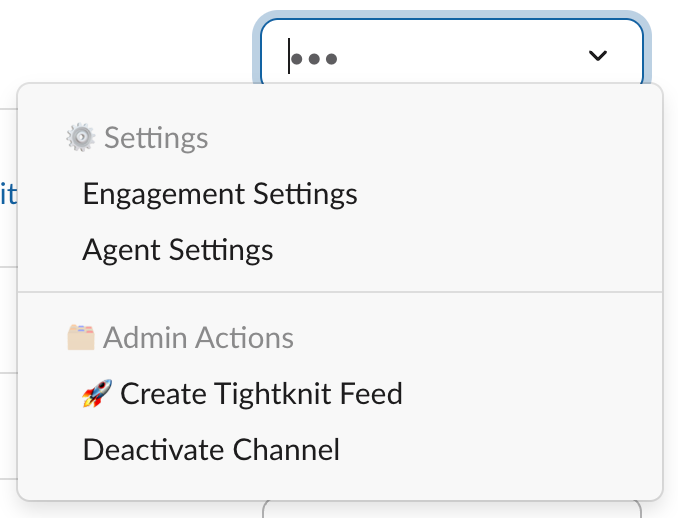
A Feed is created automatically when you activate a channel, including during the guided setup to activate a channel, and you’re offered a Publish Feed button for it. Publishing makes the Feed Public on your community site and adds it to the site’s navigation menu in one click; click Customize instead to choose the settings yourself. A Feed on a private channel always goes to its settings instead, so you choose who can see it. If an activated channel doesn’t yet have a Feed, you can create one manually by clicking the Create Tightknit Feed option within the dropdown menu of the channel settings.
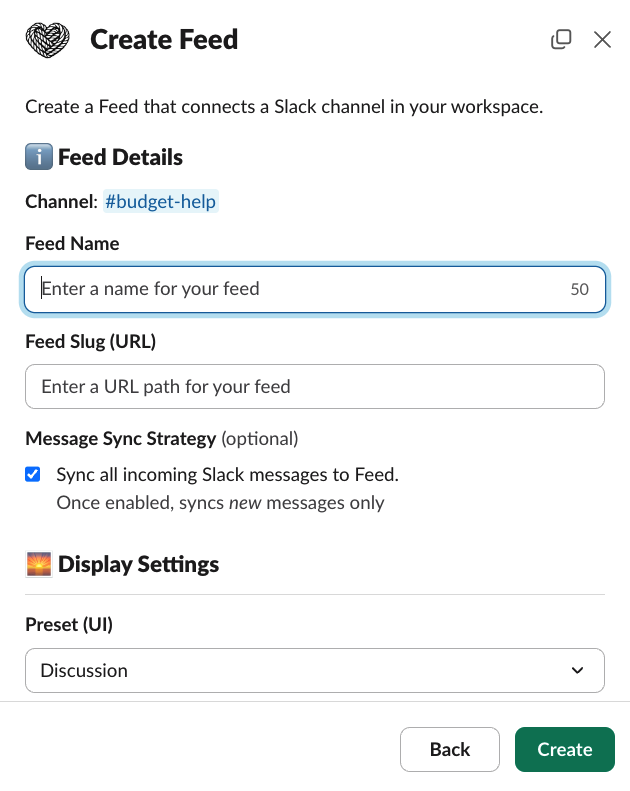
These are the same fields the Studio create form uses, described under Creating a Feed in Studio. The steps below show the Slack modal.In the Feed creation modal you can configure the following settings:
Selected Channel - The channel that this Feed will listen to for new messages.
Feed Name - The name of the Feed.
Feed Slug - The URL path for the Feed. Keep this short and simple (only use lowercase letters, numbers, or the following characters: - and _). Try not to change this often as it would break users’ existing links and bookmarks.
Preset - The Tightknit community site UI display preset for the Feed. This is used during Feed creation to determine default values for display settings such as List View Display and Post Detail Display. The display values can be overridden in the optional settings below.
Message Sync Settings - By default, Tightknit will sync all incoming new Slack messages and replies to the Feed, including messages from bots, starting from the time that this setting is enabled. If you do not want to auto-sync messages (e.g., you prefer to manually sync select posts using the shortcut), uncheck this option.
Disallowed Bots - Messages from all bot users sync into Feeds by default. If you don’t want certain bots to appear in this Feed, add them to the Disallowed Bots list. Only messages from bots on this list will be excluded from syncing.
A Slack app that posts without a bot user is an exception: its messages never
sync, whether or not it appears on the Disallowed Bots list. This affects
Slack’s older built-in integrations, such as the RSS app, rather than apps
installed from the Slack Marketplace. See Messages from a Slack app without a
bot
user.
Additional optional settings:
List View Display - The default display setting for posts in the Feed list view, such as Snippet, Compact, Card, or Changelog. Read more.
Post Detail Display - The default display setting for the detail page of posts in this Feed, such as Discussion or Blog. Read more.
Navigation Sidebar Emoji Icon - The emoji icon, such as 📡, that is displayed next to the Feed name in the Tightknit community site sidebar using the Noto Emoji Google font. If none is set, the sidebar displays a default icon.
The Noto Emoji Google font has limited support across browsers. We highly
recommend testing your choice of emoji in the Noto Emoji Type
tester within the
major browsers.
Show Pinned Posts - Toggle to show or hide the pinned posts carousel at the top of the Feed page on the community site. When enabled, messages that are pinned in the connected Slack channel appear in a carousel above the main post list. New Feeds have this enabled by default.
AI-Generated Post Titles - Toggle to enable or disable AI-generated titles for posts synced to this Feed. When enabled, Tightknit uses AI to automatically generate a title and URL slug for each post. Read more.
Navigation Sidebar - Toggle to show or hide the Feed from navigation menus, including the sidebar on the community site.
Community site access - Controls who can view the Feed’s content on the community site. See Feed Visibility below.
Post from Site - Toggle to allow authenticated users to create new posts and comments directly from the community site for this Feed. Requires Interactivity to be enabled.
Unlisted - Toggle to hide the Feed from search engines, sitemaps, and feed listings. Unlisted Feeds are excluded from SEO (disallowed in robots.txt and excluded from sitemaps) but remain reachable by direct link.
Once you have entered the details of your new Feed, click the Create button to create the Feed.
Feed creation modal
In order to comply with privacy requirements, Tightknit will notify users
whose messages may get synced to a Feed on the community site. When a Feed is
connected to a channel, Tightknit sends a public message in the channel once.
Public notification when a Feed is connected to a channel
When a user joins a channel that has already been connected to a Feed,
Tightknit sends a private notification to the user.
Private notification when joining a channel with a Feed
The number of Feeds you can create is determined by your
plan. If you need more Feeds, please contact
Support.
By default, AI titles use sentence case and follow the author’s own wording and tone, and AI descriptions are tuned for search results. Two optional fields let you steer each one per Feed:
AI title guidance - how post titles should read.
AI SEO description guidance - how the meta description used in search results and social unfurls should read.
Write plain instructions, for example “Title Case. Lead with the product name when a post is about one.” Leave a field blank to use Tightknit’s default voice.Guidance steers tone, voice, casing, and phrasing. It cannot change the length or plain-text rules that keep titles usable on the site, so an instruction to write Markdown or a 500-character title is ignored. Each field holds up to 1,000 characters.Set this after the Feed exists, in Studio under Feeds → (your Feed) → AI & Agent Settings, or over MCP with update_feed. The guidance only applies while the Feed’s AI titles setting is on; if you turn AI titles off, the guidance stays saved but is not used.
Feed visibility controls who can view the Feed’s posts on the community site. You can configure visibility in the Community site access setting when creating or editing a Feed.
Visibility Level
Who Can View
Disabled
No one. The Feed is not exposed on the community site. A Feed that Tightknit creates automatically when you activate a channel starts here.
Public
Anyone visiting the site, including anonymous visitors.
Authenticated only
Only logged-in members of the community.
Feed members
Only members who belong to the Feed (mirrored from the connected Slack channel’s membership).
A Feed on a private Slack channel can only be Disabled or Feed members. Public and Authenticated only are never offered for it, because a private channel’s posts must stay restricted to its members.
The Home feed respects feed visibility. Logged-in members see posts from all feeds they have access to, while anonymous visitors only see posts from public feeds.
Feed visibility only applies to your community site. It does not
restrict who can see this content in the Studio. Any Studio
user whose role grants access to a page that surfaces
messages (for example, Discussions, Activities, or Members) can
view content from activated channels regardless of Feed visibility, including
messages from private Slack channels and from Feeds restricted to their
members. Control who can see this content in the Studio by managing Studio
user roles, not Feed visibility.
Feed member lists are automatically synced from the connected Slack channel’s membership. When a user joins or leaves the Slack channel, their access to the community site Feed is updated accordingly.Admins can also manage a private Feed’s member list directly from Studio. See Managing Feed members for details.
Was this page helpful?
Assistant
Responses are generated using AI and may contain mistakes.