> ## Documentation Index
> Fetch the complete documentation index at: https://docs.tightknit.ai/llms.txt
> Use this file to discover all available pages before exploring further.
# SEO and Metadata
> Control whether search engines index your community site, and add a Google Tag Manager container.
One of the main reasons to run a community site is that it makes conversations in Slack findable on the web. These settings control whether that happens.
Both live at **[Site > SEO & metadata](https://studio.tightknit.ai/-/website/seo)** in Studio.
**Did you know you can change this with our [MCP server](/integrations/mcp) too?** Try asking your agent: *"Turn on search engine indexing for our site."*
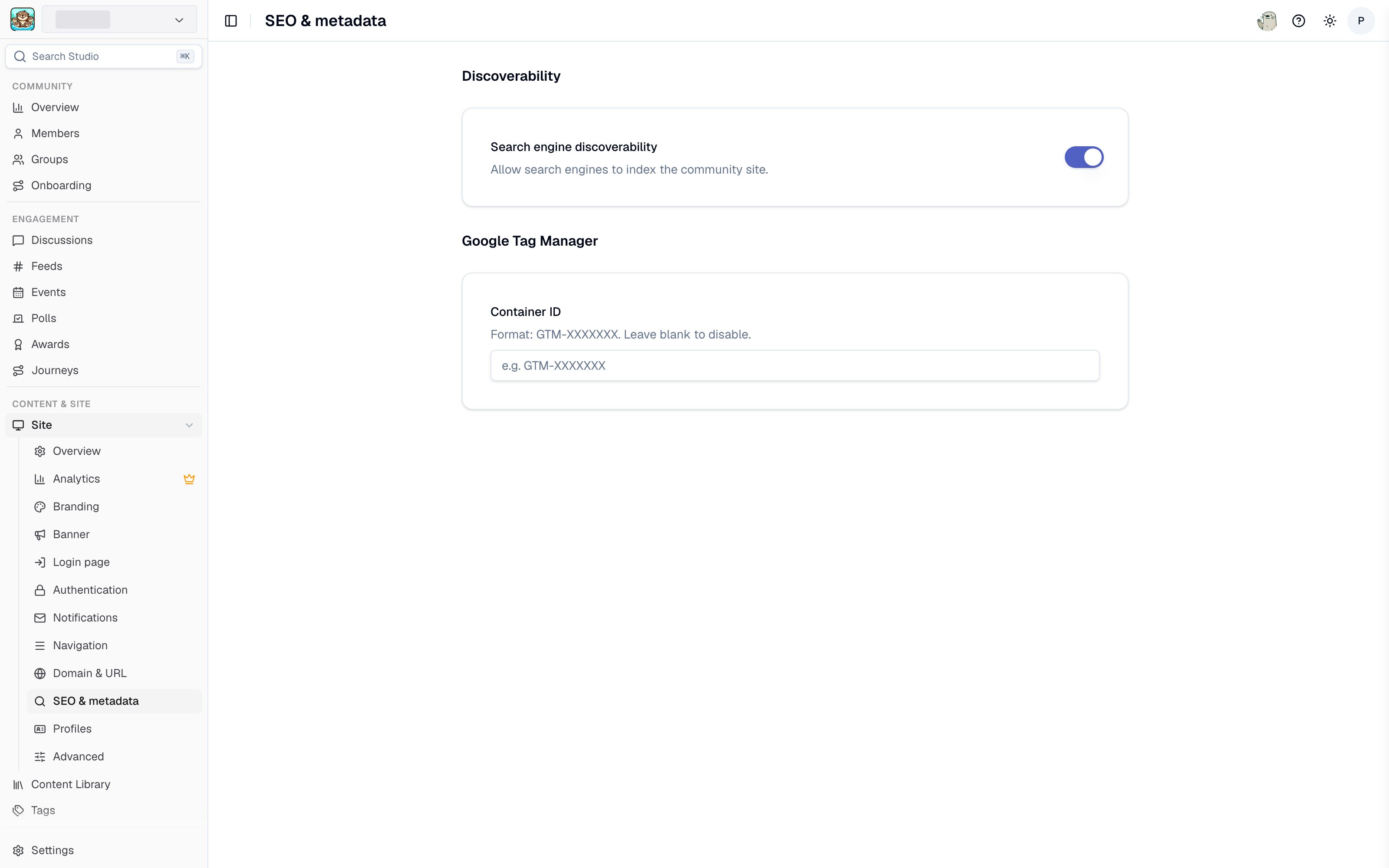 ## Search engine discoverability
The **Discoverability** setting opts your site in or out of being indexed by search engines.
* **Enabled** (the default) - your site's pages are listed in `robots.txt` and your sitemap, so search engines can crawl and index them.
* **Disabled** - your site's routes are excluded from `robots.txt` and sitemaps.
Turning discoverability off is the right choice while you are still building the site, and the wrong choice once you have launched. A site excluded from sitemaps earns no search traffic, which removes most of the reason to have one.
Discoverability is separate from [access control](/community-site/authentication#access-control-options). A site set to **Restricted access** requires login regardless of this setting, so search engines cannot index its content either way.
## Page titles and metadata
Your **site name** is used as the title in your site header and in SEO metadata, and your **site description** and **social media image** are used when pages are shared. Set all three under [Site > Overview](/community-site/general).
## Google Tag Manager
Add a **Container ID** in the format `GTM-XXXXXXX` to load your Google Tag Manager container on every page of your community site. Leave it blank to disable.
Tag Manager lets you add your own analytics, advertising, and marketing tags without touching Tightknit. For the full setup walkthrough, including the events Tightknit emits that you can build triggers on, see [Integrations](/community-site/integrations).
## Related pages
* **[Domain and URL](/community-site/custom-domain)** - a custom domain keeps search authority on your own domain.
* **[Site analytics](/community-site/analytics)** - measuring the traffic these settings earn you.
* **[Integrations](/community-site/integrations)** - Google Tag Manager in depth.
## Related topics
- [Integrations](/community-site/integrations.md)
- [Domain and URL](/community-site/custom-domain.md)
- [Site Overview Settings](/community-site/general.md)
- [Community Site Analytics](/community-site/analytics.md)
- [Overview](/community-site/overview.md)
## Search engine discoverability
The **Discoverability** setting opts your site in or out of being indexed by search engines.
* **Enabled** (the default) - your site's pages are listed in `robots.txt` and your sitemap, so search engines can crawl and index them.
* **Disabled** - your site's routes are excluded from `robots.txt` and sitemaps.
Turning discoverability off is the right choice while you are still building the site, and the wrong choice once you have launched. A site excluded from sitemaps earns no search traffic, which removes most of the reason to have one.
Discoverability is separate from [access control](/community-site/authentication#access-control-options). A site set to **Restricted access** requires login regardless of this setting, so search engines cannot index its content either way.
## Page titles and metadata
Your **site name** is used as the title in your site header and in SEO metadata, and your **site description** and **social media image** are used when pages are shared. Set all three under [Site > Overview](/community-site/general).
## Google Tag Manager
Add a **Container ID** in the format `GTM-XXXXXXX` to load your Google Tag Manager container on every page of your community site. Leave it blank to disable.
Tag Manager lets you add your own analytics, advertising, and marketing tags without touching Tightknit. For the full setup walkthrough, including the events Tightknit emits that you can build triggers on, see [Integrations](/community-site/integrations).
## Related pages
* **[Domain and URL](/community-site/custom-domain)** - a custom domain keeps search authority on your own domain.
* **[Site analytics](/community-site/analytics)** - measuring the traffic these settings earn you.
* **[Integrations](/community-site/integrations)** - Google Tag Manager in depth.
## Related topics
- [Integrations](/community-site/integrations.md)
- [Domain and URL](/community-site/custom-domain.md)
- [Site Overview Settings](/community-site/general.md)
- [Community Site Analytics](/community-site/analytics.md)
- [Overview](/community-site/overview.md)